Performance when conditions change.
Anchoring failures rarely happen at peak load. They happen when the anchor has not been correctly set in the right seabed. They happen when conditions change. Wind shifts, tidal reversals, and increasing load expose how an anchor behaves once it is already buried. Knox is designed for predictable, repeatable holding under these real-world conditions.
[ THE PROBLEM ]
Why behaviour matters.
As force increases, load transfers through the shank into the fluke. Seabed material shear and flow, accumulate and compact. The fluke geometry dictates the behaviour of the anchor which should remain in a stable position and continue to plow and fully bury.
Anchors that lose position stability under load tend to drag through the seabed and can roll out and lose their hold completely.
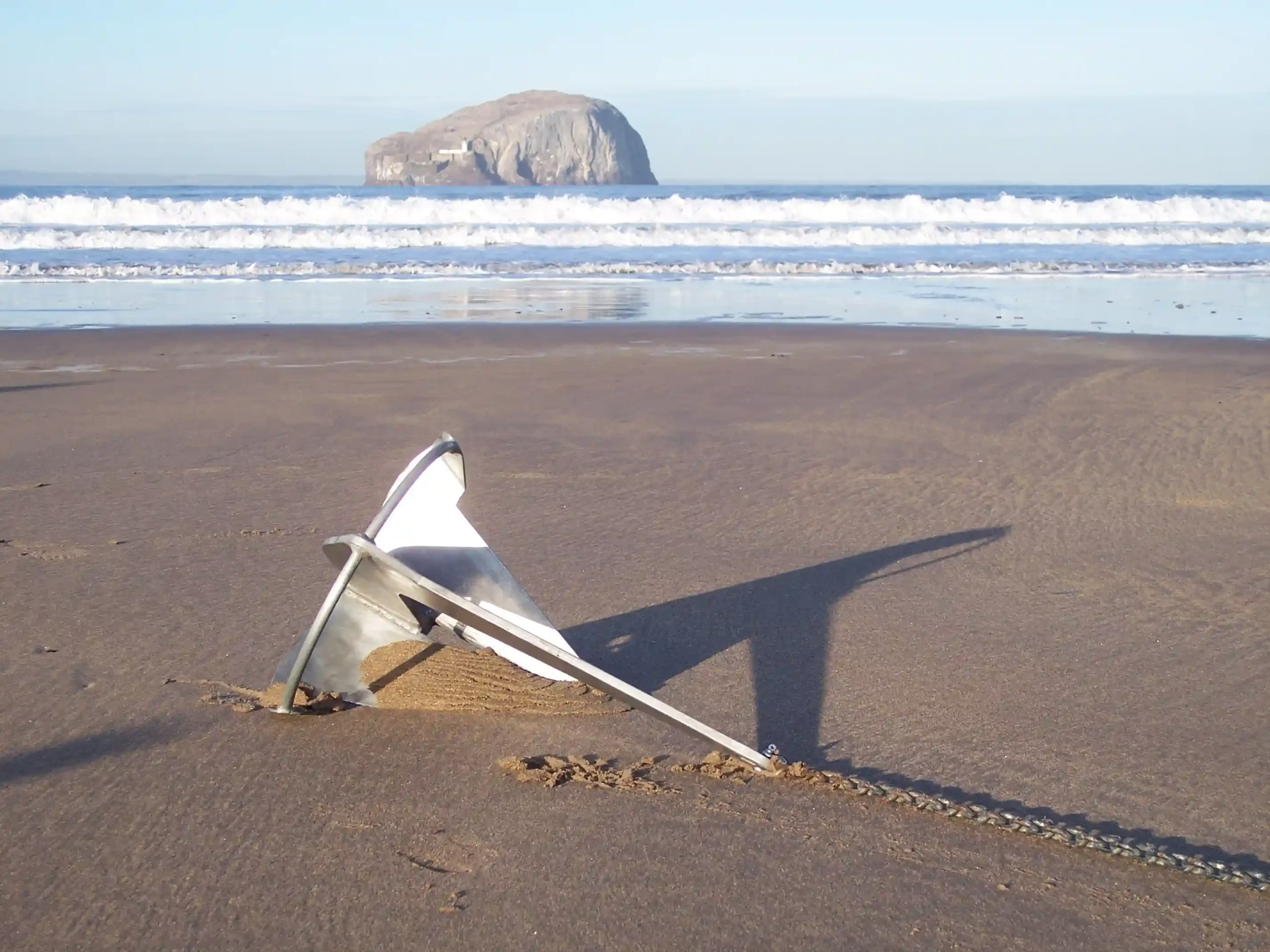
[ THE TEST ]
The repeatable holding test
Knox’s testing was developed to prioritise repeatability over spectacle. Rather than chasing dramatic peak numbers, the test applies a progressively increasing, straight-line load to a buried anchor on a consistent seabed.
Variables such as pull rate, scope, direction, and seabed type are controlled to reduce inconsistencies and allow meaningful comparison of how holding develops under load.
The result is not a single headline figure, but a behavioural profile that shows how an anchor performs as load increases and conditions evolve.
Progressive Load
Controlled increase in applied force
Single Seabed
Consistent sand conditions
Settled Reset
Force recorded after stabilisation
[ TOTAL MARKET COMPARISON]
The Curve of Confidence.
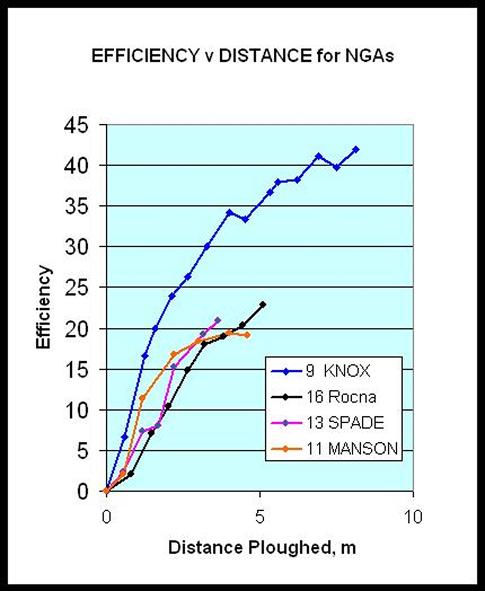
The Static Holding power describes how much force an anchor can resist without moving through the seabed. Confidence describes how predictably it reaches this limit. As load increases, anchors follow different behavioural paths. Some dig shallowly then roll out, other roll from side to side moving through the seabed, rather that remaining stable and upright whilst progressively burying.
Knox was designed to favour a stable, progressive response to load, prioritising predictable behaviour as the load increases.
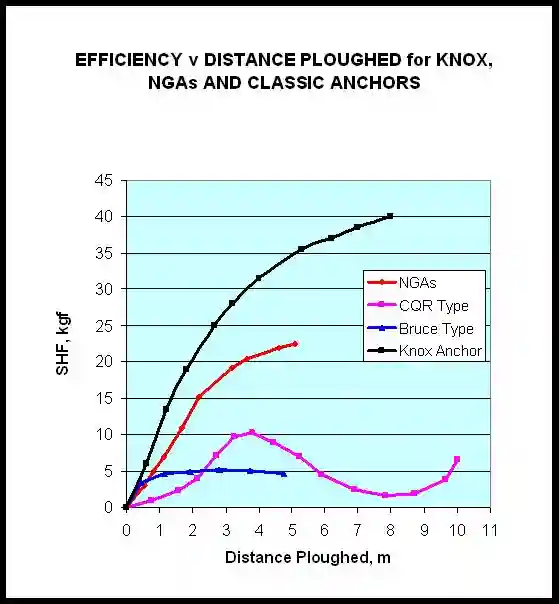
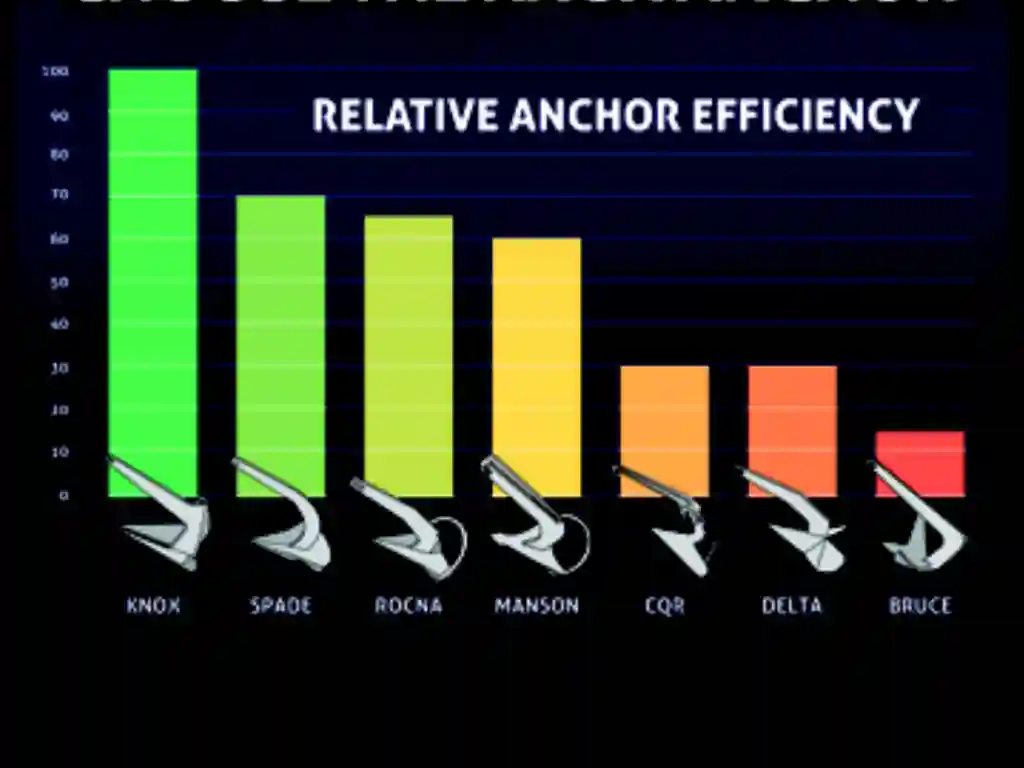
Knox vs. The World
This data compares how different anchor designs respond under controlled, repeatable test conditions as load increases.
These results are not intended to define universal performance across all seabeds or situations. They are presented to illustrate relative behaviour and efficiency within a consistent test framework.
4x
Higher holding power per kg.
+40%
More efficient.
Understand Your Real Wind Load
Your boat's displacement (weight) dictates how it rides in waves, but windage (the physical profile of the boat) dictates the raw pulling force on your anchor. Use the calculator below to estimate the force your anchor actually needs to resist.
Force = (1/500) × LOA² × Wind²
This is the approximate physical force pulling on your bow roller.
Which anchor are you upgrading from?
The anchors included in this comparison were selected to represent a range of common design approaches present at the time of testing. The purpose of the comparison is to understand behavioural differences, not to rank products by headline figures.
Vs. The "Old Guard"
If you are using a CQR, Bruce, or Delta, the difference is exponential. These older designs struggle to penetrate hard sand.
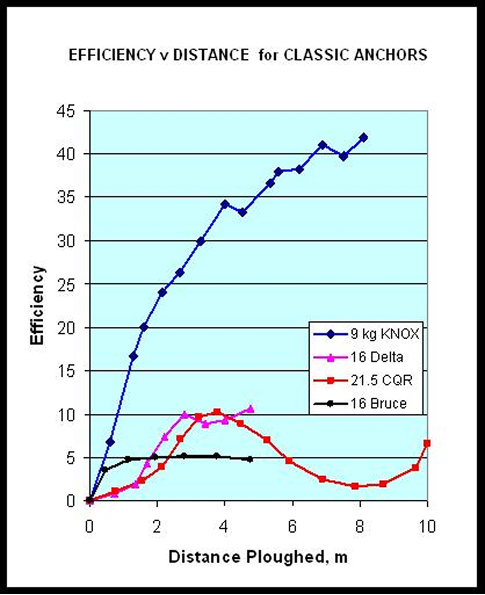
OBSERVATION:
Note the red/pink lines dropping off after 4 meters. This indicates breakout.
Vs. Modern Roll-Bars
Against Rocna, Spade, and Manson, Knox wins on “Deep Set” ability. We don’t just hold; we dive.
OBSERVATION:
The blue Knox line continues upward trajectory long after competitors flatten out.
[ THE WIND SHIFT PROTOCOL ]
When conditions change.
Changes in wind or tide introduce directional loading while the anchor remains buried. In sand and mud, Knox typically rotates within the seabed, maintaining burial during a 180° shift.Resetting generally occurs within approximately one meter.
STEP 01
The Initial Hold
Anchor is fully buried. Static hold is maximum.
STEP 02
The Rotation
As pull direction changes, the split fluke acts like a pivot point, rotating in the soil.
STEP 03
The Re-Alignment
Anchor aligns with new wind direction within < 1 meter drag distance. No breakout.
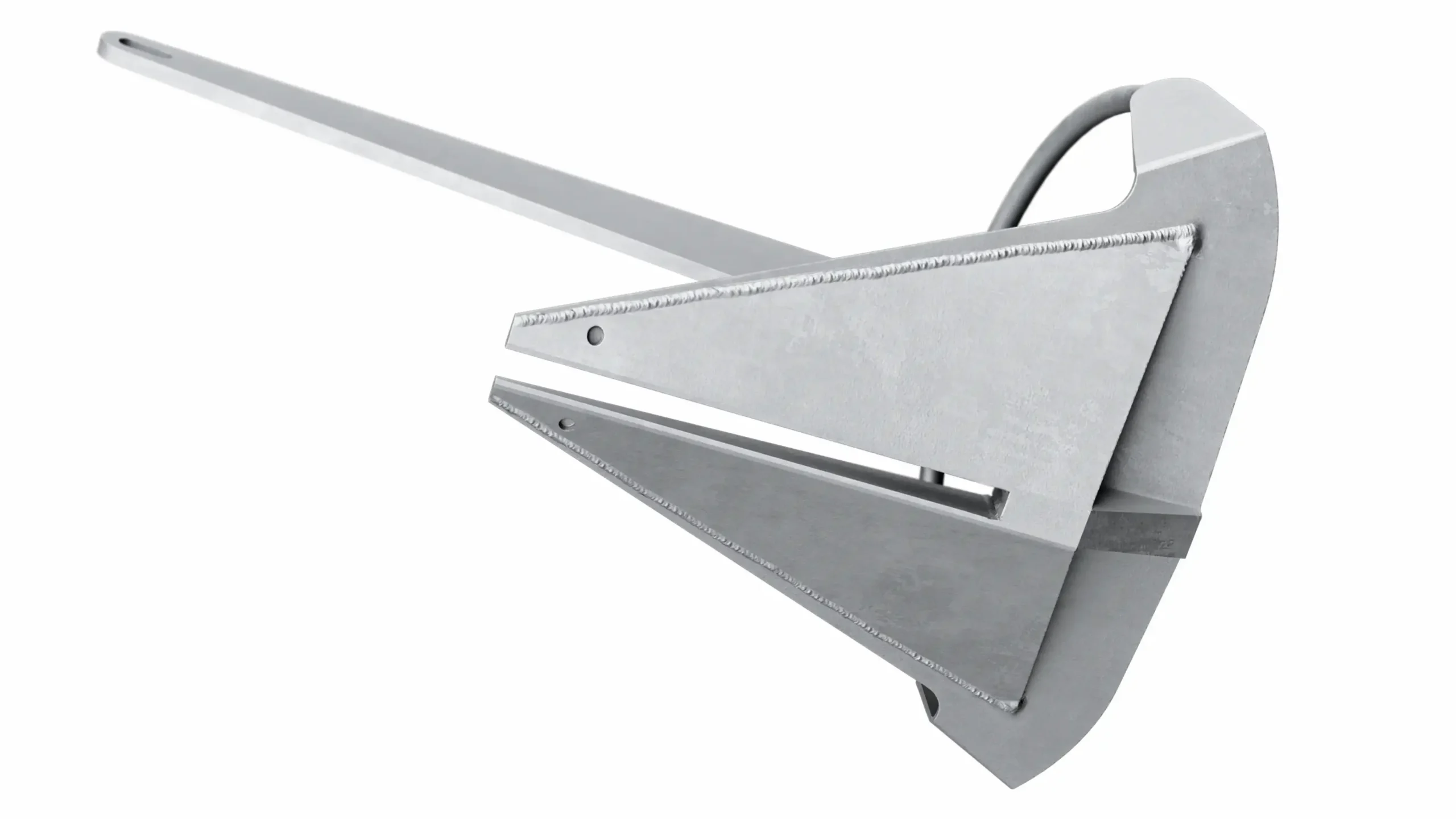
The Split Fluke.
Reduced Build Up
Helps sand and clay clear instead of packing unevenly.
Consistent Setting
Designed for steady, repeatable behaviour as conditions change.
Real World Behaviour
Optimised for the seabeds people actually anchor in, not lab conditions.
[ MECHANISM OF ACTION ]
Clogging vs. Flow
Why do some anchors fail at high load? Often, it’s not the steel – it’s the mud. In sticky seabeds, material can “ball up” in front of a concave fluke, turning the anchor into a smooth sphere that slides.
Concave Fluke
Material gets trapped, creating a “soil cone” that reduces friction.
RESULT: SLIDING
Knox Split Fluke
The split allows material to escape, keeping cutting edges clean.
RESULT: DEEPER DIVING
Independent Verification
The testing method was developed before the anchor itself, but don’t take our word for it.
YACHTING MONTHLY
“The holding power was simply off the chart… we couldn’t break it out.”
RATED: BEST ON TEST
PRACTICAL BOAT OWNER
“Set immediately and held firm as load increased linearly.”
RATED: RECOMMENDED
PROF. JOHN KNOX ANALYSIS
“Comparative analysis of fluke geometry efficiency in soft mud substrates.”
PUBLISHED: 1998
The External Audit.
We do not ask you to take our word for it. Review the independent tests, community discussions, and scientific heritage of the Knox Anchor.
Press & Testing
VIDEO TESTIndependent, real-world seabed testing and visual holding observation.
EDITORIAL ROUNDUPFeatured in the "Best Anchors: 8 New Generation Designs" buyer's guide.
TECHNICAL FEATUREAnalysis of the best boat anchor types for different cruising conditions.
MAGAZINE ARCHIVE (PDF)Legacy independent performance review.
Community & Data
Peter Smith's technical compilation of anchor holding data featuring Knox.
PRESENTATION (PDF)SV Soggy Paws technical seminar referencing Knox mechanics.
Academic Authority
INSTITUTIONAL BIOOfficial biography of Professor John Knox (FRS), detailing his academic career and the commercial success of the Knox Anchor.
EDITORIAL KNOWLEDGEEducational article referencing the foundational research behind the Knox design.
Full Specifications Data
Dimensional Data
Calculated at ~40x anchor weight. Point at which ploughing begins.
Construction & Materials
Yield: 690 MPa
Load Context (35ft Vessel Example)
30 knots → ~202 kg
42 knots → ~397 kg
52 knots → ~616 kg
60 knots → ~810 kg
Note: An 18 kg anchor provides sufficient holding capacity for a 35ft vessel up to approximately 52–60 knots, depending on seabed and shock loading.
G70 provides higher strength at reduced diameter and weight. Breaking loads vary by manufacturer; figures shown are typical.
| Diameter | G30 (t) | G40 (t) | G70 (t) |
|---|---|---|---|
| 6 mm | ~1.6 | ~2.5 | ~4.0 |
| 7 mm | ~2.1 | ~3.0 | ~5.0 |
| 8 mm | ~2.8 | ~4.0 | ~7.0 |
| 10 mm | ~4.4 | ~6.5 | ~11.0 |
| 12 mm | ~6.0 | ~9.0 | ~15.0 |
| 14 mm | ~8.0 | ~12.5 | ~20.0 |
Weak-Link Philosophy: Only use rated, high-quality shackles from reputable manufacturers. The common approach is for the shackle to act as the weak link. In foul ground, a tripping line is recommended.
Swivels: Optional and situational. Most useful in tidal anchorages where the boat may rotate. Poor-quality swivels introduce a weak point. Recommended solution: three-link chain plus a high-quality swivel.
- Holding values are guideline figures, not guarantees.
- Wind and wave loads are dynamic, not static.
- Nylon snubbers significantly reduce shock loads and improve real-world holding performance.
Test Context
MEDIUM DENSITY SAND
CONTROLLED LINEAR PULL
NOT APPLICABLE TO ROCK
Note: These results describe mechanical behaviour in penetrable seabeds. In rock or heavy kelp, purely mechanical holding is replaced by hooking.
Built by engineers, not marketers.
Knox anchors are the result of 30 years of conservative, engineering-led development in Scotland. No trends. Just physics.